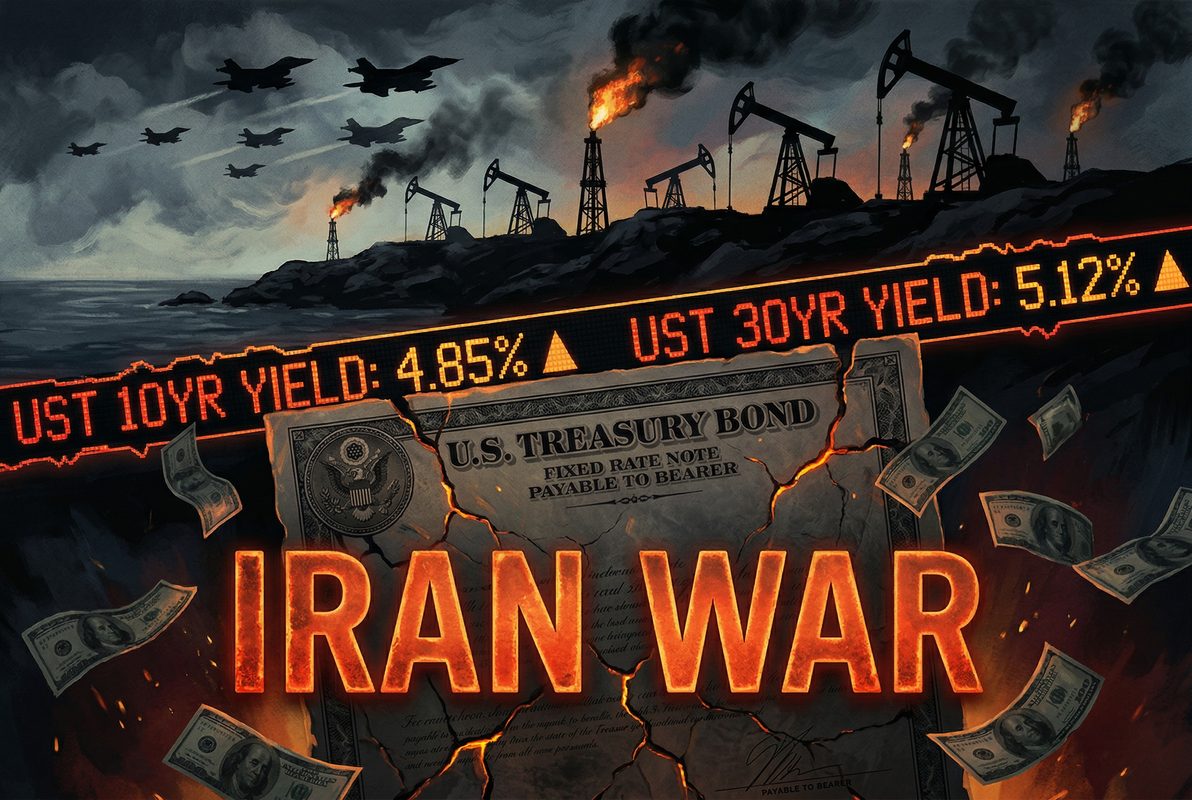
The Iran War & Mortgage Rates: What Every Borrower Needs to Know Right Now
When the U.S.-Israeli military campaign against Iran began in late February 2026, mortgage rates had just dipped below 6% — a milestone that hadn't been seen since 2022. Within two weeks, they climbed back to 6.11%, then to 6.19%, wiping out months of progress in housing affordability. For anyone in the middle of a home purchase or refinance, this volatility is not just alarming — it's costly. Here's what's really happening, why it matters to your wallet, and what you should do about it today.
1. The Flight-to-Safety Paradox: Why This War Raised Rates Instead of Lowering Them
Historically, geopolitical crises outside U.S. borders send investors rushing to the safety of U.S. Treasury bonds. Increased demand for Treasuries drives their prices up and yields down — which lowers mortgage rates. This "flight to safety" effect played out clearly during the Greek financial crisis in 2011 and after the Brexit referendum in 2016, both of which triggered mini-refinance booms in the U.S. as rates temporarily fell.
The Iran War has been different. Rather than fleeing to U.S. Treasuries, global investors are questioning whether the U.S. itself is a safe harbor — not just because of the war, but because of growing concerns about American fiscal discipline, rising war-related spending, and inflation re-igniting. The 10-year Treasury yield jumped from 3.96% on February 27 to 4.38% by late March 2026 — a 42-basis-point move in less than four weeks.
Source Credibility
Freddie Mac Primary Mortgage Market Survey (data: Feb–Mar 2026) — the gold standard for U.S. weekly mortgage rate reporting, published weekly by the Federal Home Loan Mortgage Corporation, a government-sponsored enterprise. Cited by the New York Times, CNN Business, and RefiGuide.org.
2. Oil Prices: The Inflation Engine Driving Rates Higher
Iran controls a significant share of global oil supply and sits at the mouth of the Strait of Hormuz — through which roughly 20% of the world's oil passes daily. Since the conflict began, oil prices surged over 25%, climbing from approximately $71 per barrel in early March to $119.48 by March 9, 2026 — the first time above $100 since Russia's invasion of Ukraine in 2022. Qatar's Energy Minister warned of potential disruption that could push prices toward $150 per barrel.
Higher oil prices ripple through the entire economy: transportation costs rise, manufacturing inputs become more expensive, and consumer prices inch upward. This rekindled inflation is the enemy of low mortgage rates. Bond investors demand higher yields to compensate for the eroding purchasing power of their fixed-income returns.
Expert Quote
"Without the geopolitical tensions, we would likely be seeing a 10-year Treasury well south of 4%, with mortgage rates in the high 5s. All of this hinges on the price of oil."
— Jeff DerGurahian, Chief Investment Officer, loanDepot (CNN Business, 2026)
3. The Fed Is Stuck: Caught Between Inflation and Recession Risk
The Federal Reserve's dual mandate — control inflation AND support employment — is under severe strain. The OECD revised its U.S. inflation forecast upward to 4.2% for 2026, more than a full percentage point higher than its previous projection, directly attributing the increase to the Iran conflict. At the same time, rising energy costs and uncertainty are suppressing consumer spending and business investment, raising recession risks.
If the Fed cuts rates to support growth, it risks inflaming inflation further. If it holds or hikes, recession risk increases. This ambiguity creates a volatile environment for Treasury yields and, by extension, mortgage rates. Lenders have responded by widening the spread between Treasury yields and mortgage rates — adding extra margin to price in their own uncertainty.
Source Credibility
OECD (Organisation for Economic Co-operation and Development) — intergovernmental economic organization with 38 member nations. Their macro-economic forecasts are peer-reviewed and widely cited by central banks and finance ministries worldwide. Source: New York Times report on OECD forecast revision, March 2026.
4. War Spending + National Debt = Structural Upward Pressure on Yields
Military conflicts are expensive. The U.S. national debt already exceeds $38 trillion as of early 2026. Wartime spending requires additional Treasury issuance — meaning the government must sell more bonds to fund the war. When supply of Treasuries increases without a commensurate increase in demand, prices fall and yields rise. This is a structural, not just emotional, driver of higher rates that persists regardless of how quickly the conflict ends.
Dallas Federal Reserve researchers published a working paper in April 2026 analyzing the inflationary impact of oil shocks from the Iran conflict, modeling scenarios from short-term supply disruption to prolonged conflict. Their conclusion: even a moderate oil shock raises U.S. inflation by 0.5–1.2 percentage points over 12–18 months, with larger shocks compounding the effect.
Source Credibility
Federal Reserve Bank of Dallas — regional Federal Reserve bank with a dedicated research department. Working papers undergo rigorous internal peer review. URL: dallasfed.org/research/papers/2026/wp2609.pdf.
5. The Bond Weaponization Risk: Adversaries Can Pull the Trigger
Here is an angle that most mainstream coverage misses. Countries hostile to U.S. interests — particularly China, which held approximately $682.6 billion in U.S. Treasuries as of November 2025 — can deliberately sell their Treasury holdings to pressure U.S. bond markets. If done at scale during a period of war-related uncertainty, this could cause a sudden spike in Treasury yields, driving up the government's own borrowing costs and complicating its ability to fund both domestic programs and military operations.
In early 2026, reports emerged of Chinese state banks being directed to reduce U.S. Treasury exposure. While analysts debate how large the impact would actually be — given that China's share is roughly 3–4% of total outstanding U.S. debt — the signaling effect alone is powerful. It creates additional uncertainty that keeps institutional bond buyers on the sidelines, which has the same yield-raising effect as actual selling.
Sources
Investopedia (Feb 2026): "China holds $682.6 billion in Treasuries... Some analysts fear China could dump these Treasuries, weaponizing its holdings and sending interest rates higher."
Business Insider (Feb 2026): Reports on Chinese bank instructions to reduce U.S. Treasury holdings.
Forbes (Apr 2025): "U.S. stocks rallied, but soaring overnight Treasury yields suggest China may be quietly selling U.S. debt."
6. The Double-Edged Sword: A Prolonged War Could Shatter U.S. Global Standing
Short conflicts with decisive outcomes typically trigger the classical flight-to-safety response — investors run to U.S. bonds, yields drop, mortgage rates fall. But a prolonged, inconclusive war carries the opposite risk. It signals to the world that the U.S. is overextended, fiscally strained, and potentially losing the superpower status that underpins the dollar's reserve currency role.
If allied and neutral nations begin questioning U.S. creditworthiness or the permanence of dollar dominance, the flow of global capital into U.S. fixed-income assets could slow structurally. This would translate into persistent upward pressure on Treasury yields, MBS spreads, and ultimately mortgage rates — not just for months, but potentially for years.
7. MBS Market Volatility: The Direct Link to Your Mortgage Rate
Your mortgage rate is not just about Treasury yields — it also depends on the Mortgage-Backed Securities (MBS) market. MBS are bond-like instruments created by pooling mortgage loans; their yields move with Treasuries but often with a wider spread during periods of uncertainty. As of late March 2026, National Mortgage Professional Magazine reported that Treasury yields had become "increasingly unstable, pushing mortgage rates higher one day and lower the next."
Fannie Mae and Freddie Mac have ramped up MBS purchases in an attempt to stabilize spreads — but the underlying volatility driven by oil prices and geopolitical risk remains. The spread between 10-year Treasuries and the 30-year fixed mortgage rate, which typically runs 170–200 basis points, has widened further during this conflict.
Source Credibility
National Mortgage Professional Magazine — industry trade publication for mortgage professionals, covering FNMA/FHLMC policy, MBS market conditions, and rate volatility. Authoritative for practitioners in the industry.
8. The Ceasefire Effect: Brief Relief, Not a Trend
American Banker reported in April 2026 that a brief ceasefire brought a short-lived reprieve for mortgage rates — but that "ongoing economic uncertainty and higher mortgage rates continue to weigh on demand," with both purchase and refinance applications falling on an annual basis. Ceasefire or not, the structural forces — oil inflation, war debt, Treasury supply — don't reverse overnight.
This is the key insight: even when headlines turn positive, mortgage rates may not follow immediately or proportionally. The underlying economic damage from an oil shock takes 12–18 months to fully work through CPI data and Fed policy. Zillow senior economist Kara Ng confirmed this transmission mechanism, noting that oil shocks drive up bond yields through inflation expectations, not just current inflation readings.
Source Credibility
American Banker — premier financial industry news publication serving banking and mortgage professionals. Published since 1836.
Zillow Research — well-credentialed housing market research arm of the largest U.S. real estate platform. Regularly cited by the Federal Reserve, CFPB, and academic researchers.
9. Historical Precedent: When Geopolitical Crisis Lowers Rates (And When It Doesn't)
The pattern from past crises teaches us a critical rule: crises that originate outside the U.S. and don't threaten U.S. fiscal integrity typically lower mortgage rates. Crises that originate in or are caused by U.S. actions, or that threaten the global position of the dollar, typically raise rates.
| Event | Impact on Rates | Why |
|---|---|---|
| Greece Debt Crisis (2011–2015) | ↓ Dropped | Capital fled Europe → U.S. Treasuries; flight to safety |
| Brexit Vote (June 2016) | ↓ Dropped sharply | Global uncertainty → U.S. bond demand surged; refi boom followed |
| Russia-Ukraine War (Feb 2022) | ↑ Rose (mixed) | Oil shock + U.S. involvement → inflation fears outweighed safety demand |
| Liberation Day Tariffs (Apr 2025) | ↑ Spike | U.S. fiscal credibility questioned; bond yields spiked sharply |
| Iran War (Feb–present 2026) | ↑ Rising | Oil shock + war spending + adversary bond selling risk |
10. The Scenario Nobody Is Talking About: A U.S. Quick Win
While the current market narrative is focused on the risks of a prolonged conflict, there is an underappreciated scenario that could dramatically reverse mortgage rate pressure: a swift, decisive U.S. military victory.
History offers a clear precedent. During the Gulf War of 1990–1991, oil prices spiked sharply when Iraq invaded Kuwait, driving inflation fears and pushing bond yields higher. But when the U.S.-led coalition achieved a rapid military victory in February 1991, markets snapped back with remarkable speed. Oil prices fell 31% between January and March 1991. The S&P 500 gained 13.6% in the same period. And critically for mortgage borrowers: Treasury yields fell approximately 80 basis points by the ceasefire — a massive bond market rally that translated directly into lower mortgage rates.
A quick U.S. win against Iran would likely trigger several simultaneous tailwinds for mortgage rates:
- 🛢️
Oil price collapse
A rapid end to Strait of Hormuz shipping risk would send crude prices sharply lower. Every $10 drop in oil historically removes roughly 0.1–0.2 percentage points of inflationary pressure from the economy within 3–6 months.
- 🏦
Treasury flight-to-safety revival
A demonstrated U.S. military capability and decisive outcome would reassure global investors in U.S. power and creditworthiness. Capital that fled to the sidelines — or into gold and commodities — would rotate back into U.S. Treasuries, driving prices up and yields down.
- 📉
Fed rate cut path reopens
With oil-driven inflation pressures easing, the Federal Reserve's path to rate cuts would be clearer. Lower short-term rate expectations pull long-term Treasury yields down as well, amplifying the bond market rally.
- 🌐
Restored U.S. global confidence
A clean military win reinforces the dollar's reserve currency status and U.S. geopolitical leadership. This structural support for U.S. fixed-income demand could persist well beyond the immediate post-war period.
- 💸
MBS spread compression
Lenders would reduce the risk premium baked into mortgage rates above Treasuries, amplifying the rate drop beyond what the Treasury yield movement alone would suggest.
But Don't Count on It — Even a "Win" Is Complicated
The Financial Post's mortgage analyst Robert McLister raises a critical nuance: "The assumption that a United States 'victory' would end attacks on shipping in the Strait of Hormuz is deeply flawed and runs contrary to both modern military doctrine and historical precedent." Iran's asymmetric capabilities — proxy militias, drone swarms, cyberattacks, and the ability to destabilize neighboring states — mean that even a conventional military defeat may not eliminate threats to oil infrastructure for months or years.
Unlike the 1991 Gulf War, where Kuwait's liberation was a clean geographic objective, "winning" against Iran involves no such clarity. The country's theocratic government, dispersed nuclear program, and regional influence networks are not destroyed by conventional airstrikes. Markets may celebrate a quick win initially — and oil prices may temporarily drop — but sustained residual threats could keep prices elevated, limiting how far mortgage rates actually fall.
Quick Win Scenario: What Could Mortgage Rates Look Like?
| Outcome | Oil Price Direction | 10-Yr Treasury | 30-Yr Mortgage Rate |
|---|---|---|---|
| Clean swift victory, full stability | ↓ $70–80/bbl | ↓ 3.6–3.8% | ↓ 5.5–5.75% |
| Military win + residual threats | → $90–105/bbl | → 4.0–4.2% | → 6.0–6.3% |
| Prolonged or escalating conflict | ↑ $120–150/bbl | ↑ 4.5–5.0% | ↑ 6.75–7.5% |
*Illustrative scenario estimates based on historical rate-yield correlations and current market conditions. Not a forecast.
The bottom line: a genuine quick win could be very good news for mortgage rates — potentially pushing the 30-year fixed back toward the high 5s. But the market will need to see sustained evidence of stability, not just a military announcement, before pricing that outcome fully into bond yields. And if that drop does come — refinancing will be on the table.
11. The Verdict: Unpredictability IS the Trend
From better.com research (April 2026): "The price of oil spiked, bond yields climbed, and it wasn't long before we saw mortgage rates rising." The five forces outlined above — oil-driven inflation, war spending, Treasury weaponization, MBS spread widening, and eroding U.S. credibility — are all pushing in the same direction right now. A ceasefire or peace deal could quickly reverse some of this. But no one — not the Fed, not Wall Street, not geopolitical analysts — can reliably predict when that happens, or what escalation might come next.
That unpredictability is itself the signal for borrowers. When the range of outcomes is this wide, the decision calculus changes. It is no longer about predicting the future — it is about managing asymmetric risk.
The Bottom Line for Borrowers: Lock Now. Here's Why the Math Demands It.
If you have a loan in process and you're trying to decide when to lock — stop waiting. The rational choice is to lock today. Here is the quantified opportunity cost analysis:
Example: $600,000 Refinance, 30-Year Fixed
Current loan P&I payment: $3,950.43/month
New loan at 6.000%: $3,597.30/month
Scenario A: You Lock at 6.000% — Rate Later Drops to 5.875%
Your locked payment: $3,597.30/month
What you could have gotten: $3,549.23/month
Monthly overpayment: $48.07
You pay an extra $48.07/month for up to 7 months — the typical time to refinance again — before you can refi to the lower rate. Total worst-case cost of locking: $336.54.
And remember: refinancing to 5.875% is absolutely an option. The refi cycle restarts with permanent savings locked in.
Scenario B: You Don't Lock — Rate Jumps to 6.25%, Stays There 7 Months
You stay on your old loan at $3,950.43/month
Savings you're missing vs. your 6.000% locked refi: $353.13/month
After 7 months, the rate finally drops back to 6.000% and you lock.
Total cost of NOT locking: $2,471.89 in missed savings.
Not locking costs 7.3× MORE than locking
Worst-case cost of locking: $336.54 | Worst-case cost of waiting: $2,471.89
Difference: $2,135.35 — over 6× the cost of the lock scenario
The asymmetry is stark: if you lock and rates drop, you lose a few hundred dollars temporarily before refinancing to the lower rate. If you don't lock and rates spike, you lose thousands — and unlike a rate drop scenario, there's no automatic remedy. You're stuck waiting for the market to come back, with no guarantee of timing.
Lock now. If the rate drops after, refinance. At Tiger Loans, we will help you do exactly that.
Frequently Asked Questions
Does a war always push mortgage rates higher?
Not always. Wars that originate outside the U.S. and don't threaten U.S. fiscal credibility often trigger a flight to U.S. Treasuries, pushing yields down and mortgage rates lower — as happened after Brexit in 2016. The Iran War is different because of the oil price shock and its direct inflationary consequences inside the U.S.
How closely do mortgage rates track the 10-year Treasury yield?
Very closely. The 30-year fixed mortgage rate typically runs 170–200 basis points above the 10-year Treasury yield. When the 10-year yield rises from 3.96% to 4.38% (as happened in Feb–Mar 2026), mortgage rates follow — though the spread itself can also widen during volatile markets.
Can a ceasefire reverse the rate increases quickly?
Partially and slowly. A ceasefire would lower oil prices and reduce inflation expectations, but the structural effects — war spending, Treasury supply increase, damaged global credibility — take much longer to resolve. Rates may ease somewhat but a full reversal requires sustained stability.
What is MBS, and why does it matter for my mortgage rate?
Mortgage-Backed Securities (MBS) are bonds created by pooling mortgage loans. Most mortgages are packaged into MBS and sold to investors via Fannie Mae or Freddie Mac. The yield investors demand on MBS directly determines the mortgage rates lenders can offer. When MBS yields rise — as they have amid the Iran War — mortgage rates rise with them.
Is it a good time to refinance right now?
If your current rate is above 6.5% and you qualify for a loan at 6.00% or below, the math often makes sense — especially given the uncertainty ahead. Contact a Tiger Loans mortgage professional to run your specific numbers.
Quick Summary
- →The Iran War has pushed 10-year Treasury yields from 3.96% to 4.38%+ in weeks
- →Oil prices surged 25%+, rekindling inflation and keeping the Fed on hold
- →Unlike Greece/Brexit crises, this conflict directly threatens U.S. inflation and creditworthiness
- →Adversary nations hold $600B+ in U.S. Treasuries and can weaponize them
- →MBS spreads are widening, amplifying the rate impact for borrowers
- →Ceasefire relief is temporary — structural pressures persist for 12–18 months
- →For a $600K refi: not locking costs up to 7.3× more than locking if rates spike
- →Recommendation: Lock your rate today. Refinance later if rates drop.
Related Articles
Don't Wait for the Market to Decide for You
Talk to a Tiger Loans mortgage professional today. We'll run the numbers, explain your options, and help you lock with confidence.
Talk to a Loan OfficerThis article is for informational and educational purposes only and does not constitute financial, legal, or investment advice. Mortgage rates, yields, and market conditions referenced are based on publicly available data as of April 2026 and are subject to change. Consult a licensed mortgage professional for personalized guidance. Tiger Loans, Inc. NMLS #1169300. Licensed in AZ, CA, CO, FL, GA, ID, IL, IN, MD, NV, NC, TX, WA. Broker in MA and VA. Equal Housing Lender.